
In 2025, excise duties on tobacco brought in more than €1 billion to the budget, 95% of which came from purchases made by non-residents. A fragile windfall: on 16 July, the European Commission presented a draft revision of the Tobacco Tax Directive (2011/64/EU). The aim of this text is to harmonise the minimum rates of excise duty across the Member States and to extend taxation to new products such as electronic cigarettes, heated tobacco and nicotine sachets. The European Commission justifies this reform by the "obsolescence" of the current framework, with price differentials having reached a level deemed "incompatible with public health objectives".
According to the proposal, the new rates should come into force in 2028, with a four-year transition period for certain products. The EU executive estimates that full harmonisation would enable the Union to generate around €15 billion in additional tax revenue per year, while reducing healthcare costs by almost €6 billion through lower consumption. The EU also points out that "new products" already account for 13% of the total value of the European tobacco market.
For Luxembourg, the impact would be immediate: the price of a packet of cigarettes would rise from €5.10 to around €8.30, according to estimates based on average European levels. Such an increase would wipe out overnight Luxembourg's competitive advantage over its neighbours, an advantage to be taken in a package including petrol and alcohol. In 2025, revenue from tobacco will amount to €1.07 billion. If virtually all cross-border or passing purchasers switched to their home market, tax receipts could fall to around €50 million, representing a potential loss of close to €1 billion a year - 3.5% of the total State budget (€29.57 billion), according to the Luxembourg Central Bank.
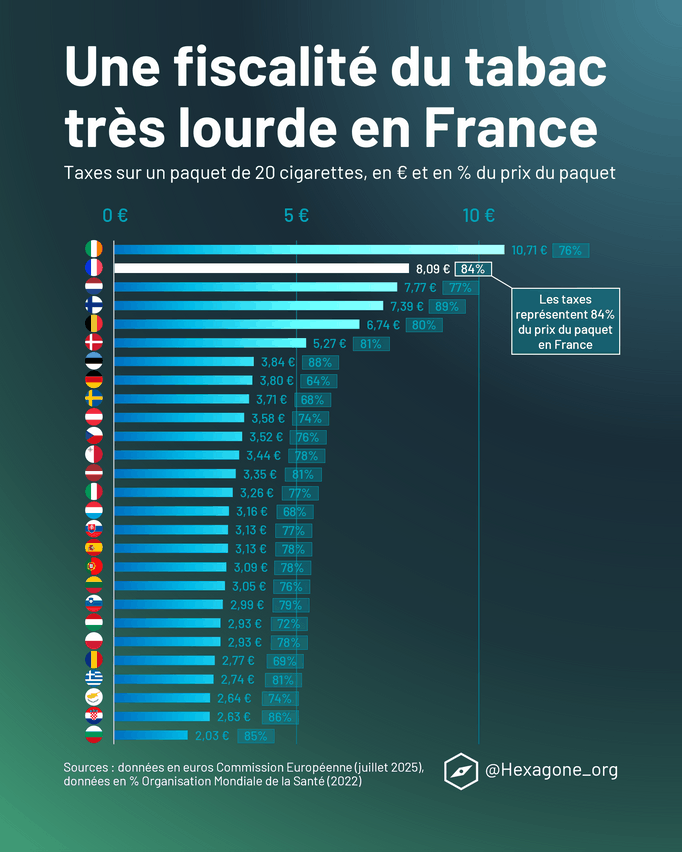
The average tax burden, in euros and as a percentage, for 20 cigarettes, in each European country. (Source: "Tabac en France: plus de taxes, donc moins de recettes?" by Hexagone)
This scenario would be the exact opposite of the one seen in France, where ever-increasing prices have caused legal sales to plummet and the parallel market to swell: customs estimates that around 20% of cigarettes consumed escape national taxation, a rate raised to 38% according to EY-Parthenon and up to 50% according to KPMG. As a result, despite a pack costing more than €10, French tobacco revenues have fallen by 12% since 2020. Luxembourg, on the other hand, has benefited from this price differential. But European harmonisation would threaten this discreet income, often described as a "tax export".
Two record seizures in one year at the airport
The paradox is that the country is only apparently benefiting from this situation. The Ministry of Health points out that tobacco is responsible for around 11% of deaths in Luxembourg, according to data sheet D001 published in 2025. The HBSC 2022 survey of teenagers shows that 9% of young people aged 15 to 18 regularly consume alcohol, tobacco and cannabis - a generation in which addiction sets in early. At European level, the WHO estimates that the economic costs of tobacco (care, productivity, premature mortality) represent between 1% and 4% of GDP. Applying an average of 1.5% to Luxembourg, the annual health burden would be around €1.3 billion, or as much as the tax revenue from tobacco.
The fight against cancer is a good illustration of this hidden cost. The Comparator Report on Cancer in Europe 2025 puts direct cancer-related expenditure in Luxembourg at 261 million euros, or almost 8% of total healthcare expenditure. If you add in prevention, research and lost productivity, every euro collected on tobacco almost ends up going back into healthcare.
This year, customs recorded two records for seizures at Luxembourg airport: in April, more than 121.Between August and October, more than 210,000 cigarettes were intercepted, as well as several dozen kilos of shisha tobacco. According to the customs officers, these cigarettes were "intended to be smuggled onto the European market". The traffickers' modus operandi was also revealed: the products were concealed in the luggage of passengers "mainly from Turkey and Armenia". These records testify to an intensification of trafficking, often fuelled by price differentials within the EU. Harmonisation of excise duties could reduce these differences - but at the cost of a loss to public finances.
These estimates remain fragile: the evaluation of the externalities of tobacco depends on numerous parameters, and the Luxembourgish share of the market remains difficult to isolate since less than 5% of the tobacco sold in Luxembourg is actually consumed in the country. But the trend is clear. If the European tax system eliminates the price differential, the Grand Duchy could lose a billion in revenue and perhaps, in the long term, save as much in health costs. An unstable balance, where tobacco money feeds the budget as much as it burns it.


