The fund is targeting €500m. However, it does not yet exist, has received no investor commitments and owns no land. What Cypher Capital is beginning to sell from Luxembourg is, first and foremost, a promise: to find, across Europe, the ‘power sockets’ that will power the future artificial intelligence data centres.
The Cypher European Data Centre Opportunities Fund is targeting an initial close of €150m. Royalton Partners has begun its pre-marketing campaign with professional investors. Storm Group, the affiliate responsible for building the portfolio, is evaluating sites in several European countries, some of which are reportedly the subject of letters of intent. The group has not disclosed their locations or the secured or negotiated capacity.
The project illustrates how value flows between electricity generators, landowners, data centre operators and investors. Its core asset is neither the building nor the server, but the amount of electricity available on a specific plot of land, at a date certain enough to sign a contract and raise debt.
Commitments extending into the 2060s
As at 30 June 2026, Microsoft, Meta, Amazon, Alphabet and Oracle had collectively signed leases totalling $1,090.5bn that had not yet commenced. Meta added approximately $68bn in July, Alphabet signed a contract worth $5.8bn, and Nvidia reported $25bn as at 26 July. The total stands at $1,189.3bn.
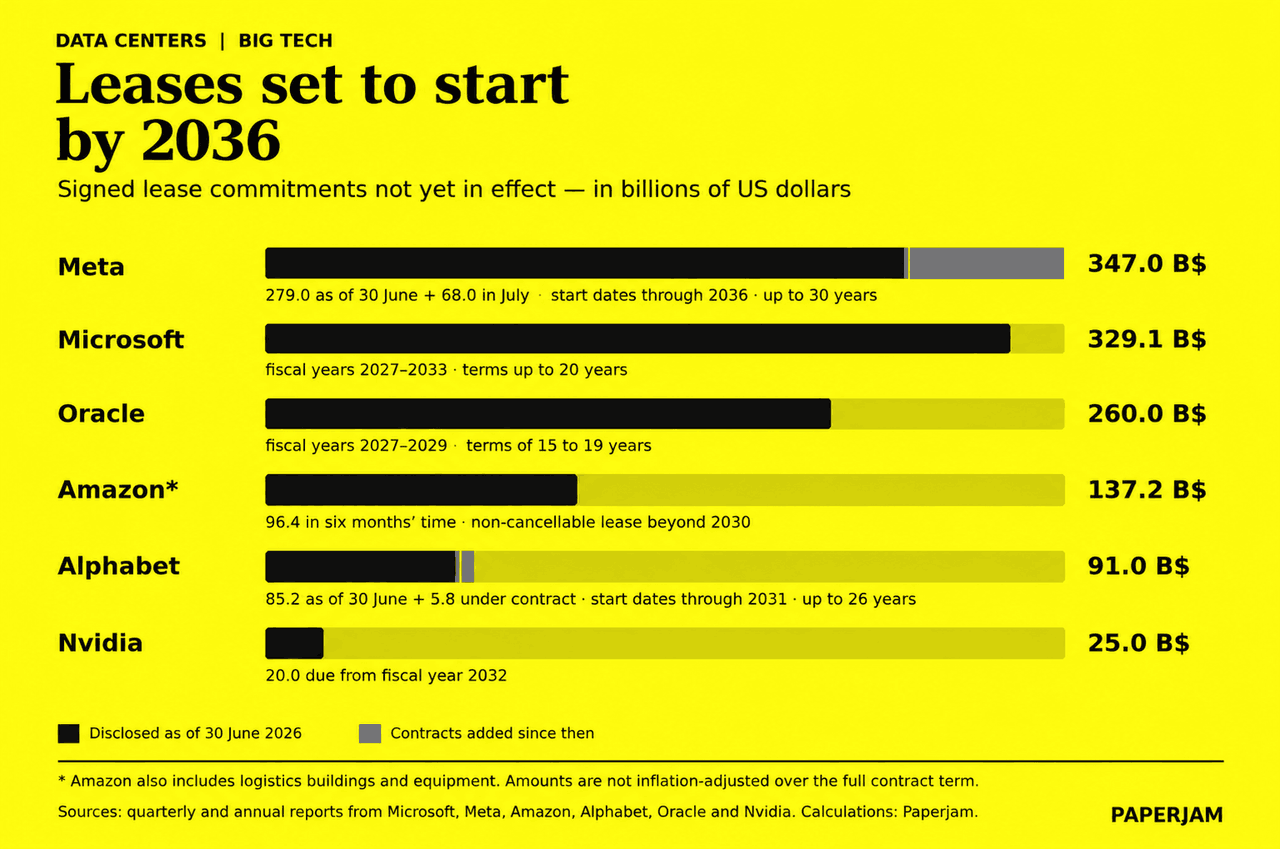
The total number of leases secured by Big Tech companies, according to their annual results. (Infographic by Paperjam created using ChatGPT)
This sum represents neither an expense already incurred nor an annual rent. It comprises the sum of future, undiscounted payments due over the entire term of contracts signed for infrastructure that is not yet available. Until the leases commence, the assets corresponding to the rights of use and the lease liabilities are not generally recognised on the balance sheet. Suppliers nevertheless have an economic obligation to secure the land, reserve capacity, obtain permits, construct the buildings and deliver the promised capacity.
Microsoft is seeing rapid growth. Its signed but unstarted leases totalled $6.9bn in June 2020, $42.1bn in 2023, $117bn in 2024 and $329.1bn in 2026. The total value has increased nearly 48-fold in six years. The leases will commence between the 2027 and 2033 financial years and may run for up to 20 years. Alphabet’s contracts will run for up to 26 years. Meta is planning leases that will take effect by 2036, with terms of up to 30 years. Commitments entered into today will still be generating payments well into the 2060s.
These commitments are in addition to direct investments, but cannot simply be added to them. Microsoft added $115.9bn to its tangible fixed assets during its financial year ending in June 2026. Alphabet had spent $91.4bn in 2025 on land, buildings, servers and network equipment. These investments fund current capacity; leases commit payments for future capacity.
The megawatt adds value to the land
Both categories face the same bottleneck. A chip can be ordered and a building constructed within a few years. A major electricity connection, however, can take seven to ten years – sometimes as many as 13 – in the most saturated European markets. The law firm Linklaters refers to ‘powered land’ as a plot that is already connected to the grid or has a sufficiently viable route to the electricity supply. The investor secures the plot, reserves the power capacity, obtains the necessary permits and then either builds on the site, hosts an operator or resells the site once it has become ‘permit-ready’.
For Storm Group, simply submitting a request to the network is not enough. The site must have reserved capacity or a proposal specifying the power output and connection date. It must also be inspected, authorised and equipped with cooling, water and fibre-optic connections. Cypher Capital intends to finance this transformation before reselling the sites to operators or investors.
Scarcity is already driving up prices. According to JLL data reported by Reuters, a connected site is worth an average of €2.36m per megawatt of IT load across the five main European markets. The price reaches €2.7m in Amsterdam, €2.6m in London and €2.5m in Frankfurt. It falls to €978,000 in secondary markets and to €512,000 in tertiary cities. In Bordeaux, some sites are being negotiated at around €200,000 per megawatt.
Geography follows the electricity grid. European projects due to be completed between 2026 and 2028 are located, on average, 175 kilometres from a major city, compared with 46 kilometres for those completed between 2022 and 2025. Undeveloped land accounts for 39% of the future pipeline, compared with 8% previously. Of nine European sites exceeding one gigawatt, only one is due to be built near a major city.
Traditional markets remain essential for services requiring low latency, but they lack space and capacity. In Frankfurt, restrictions on new capacity are expected to persist until the mid-2030s. The average vacancy rate for shared data centres in Frankfurt, London, Amsterdam, Paris and Dublin stood at just 6.4% in the second quarter of 2026, down from 16.9% in 2021, according to JLL. In Frankfurt, it had fallen to 3.1%.
Yondr converts rent into debt
Yondr demonstrates how physical scarcity is being turned into a financial product. The Luxembourg-based group develops and operates hyperscale data centres. At the time of its acquisition, it claimed to have secured commitments for over 420 megawatts from two major technology clients, along with a land bank enabling it to exceed one gigawatt. Its model follows that of Cypher Capital. Yondr secures the site, obtains the power supply, constructs the building and provides the cooling and electrical infrastructure. The client installs its servers and signs a long-term contract. Its creditworthiness enables the asset to be financed even before the first rent payment is due.
The consolidated financial statements in Luxembourg demonstrate both the strength and the vulnerability of the business model. Between the accounting takeover of Yondr on 30 June 2025 and the end of the year, the group generated $148.2m in revenue. Its largest client accounted for 61% of this, and its second-largest for 31%. Two unidentified groups therefore accounted for 92% of the business. Several clues point to Microsoft and Google, though their identities remain unconfirmed. Industry sources link them to the Slough and Middenmeer campuses. Neither group has responded to requests for confirmation.
By the end of 2025, contracts that had already come into force still represented more than $3bn in revenue to be recognised by Yondr, including $240.3m per year between 2026 and 2030. Lenders are thus financing a series of future payments backed by some of the world’s most creditworthy companies. However, the assets acquired as part of the deal included $2.433bn in loans. The seller, Cathexis, had presented the sale to DigitalBridge and La Caisse as a $5.8bn transaction.
Yondr Group Holdings is at the top of this chain in Luxembourg. Its consolidated scope comprised 34 entities in the country at the end of 2025. The Grand Duchy does not host the servers or handle the data traffic for the Slough, Frankfurt or Middenmeer sites. It manages the assets, liabilities and cash flows generated by these facilities.
Poseidon wants to build the power station alongside the campus
However, a site loses its appeal if the grid cannot supply electricity in time. Poseidon Energy aims to circumvent this delay by installing power stations directly on site. Incorporated in Luxembourg in December 2025 and based at the Bissen Technoport, the company is targeting data centres and military infrastructure with facilities announced to range from 2.5 to 500 megawatts.
Its system would combine fuel cells, batteries, a microgrid, heat recovery and CO2. Natural gas or biomethane would provide the necessary hydrogen. The promise of ‘carbon negativity’ therefore depends on the fuel’s origin, the capture rate and the fate of the CO2.
Poseidon claims to have ‘secured’ 561 megawatts and is aiming for more than one gigawatt in Europe by 2030, representing more than €5bn in investment. The company does not specify whether these 561 megawatts correspond to contracts, letters of intent or capacity reserved with suppliers.
Its main project, Digital Titan, is set to reach 500 megawatts in the Antwerp region. Poseidon mentions ten hectares, access to the Elia grid, a gas connection from Fluxys and integration into the Antwerp CO2 transport corridor. A first 10-megawatt unit is scheduled for 2027, followed by a 25-megawatt unit in 2028. Neither Elia nor Fluxys have publicly confirmed the claimed capacities.
Founder Bjorn Van Haver’s career has involved experience with fuel cells, but not yet with a 500-megawatt site. His former company, Elugie, signed a €10m contract with Solidpower in 2017 for at least 550 BlueGen units, and then announced an agreement with Bloom Energy in 2023 for five sites in Northern Europe. Poseidon does not name its current supplier nor specify which part of the technology it is developing itself.
The company plans to finance its power stations through project vehicles incorporating debt and external capital. Its head office and holding company are based in Luxembourg, whilst its technical department is located in Mechelen and its R&D in Riga. Like Yondr and Cypher Capital, Poseidon is therefore not primarily seeking a location in Luxembourg for its infrastructure. Instead, it is establishing the entity there that will be responsible for financing it.
The chain begins before the first server
Cypher Capital, Storm Group and Poseidon are, to varying degrees, still at the stage of proving their concepts. Cypher has not yet announced any fund closings or acquisitions. Storm credits its founding team with more than 550 megawatts of infrastructure developed or operated since 2017, mainly for digital asset mining, without publishing a list of these projects. Poseidon does not name its institutional investors or the customers associated with its 561 megawatts. Yondr has assets and revenue, but relies on two customers for 92% of its business.
These differences in maturity do not negate the common trend. Investors are seeking value at an ever-earlier stage: in the land before the building, in the contract before the rent, and now in the power station once it has been built, even before it is connected to the grid.
Nvidia is also scaling back its expectations. In addition to $25bn in future lease payments, the manufacturer may invest up to $2.1bn in Iren to support 5GW of infrastructure. In Ohio, it has invested $1.5bn in SB Energy and is guaranteeing part of the payments for a campus leased to OpenAI for 20 years. The project envisages up to 8GW of computing capacity.
The financial chain thus begins several years before the first machine is installed. A developer assesses the site. A network operator commits to supplying megawatts. An investor funds the permits. A private power station may complete the connection. A hyperscaler signs a lease. Banks lend against its future payments. Stabilised rental income then enables a bond issue or refinancing.
The $1,189.3bn pledged by the Big Tech companies does not guarantee the delivery of all this capacity. It reflects the financial demand that has already been generated for infrastructure that does not yet exist. Between the contract and the server lies a physical constraint: generating, transmitting and delivering the promised electricity. The risk arises when a 20-year commitment is hampered by a delayed megawatt, a refused planning permission or a local authority that no longer wants the facility. The next asset class in AI could well be powered land. Its primary vulnerability will remain the power socket.