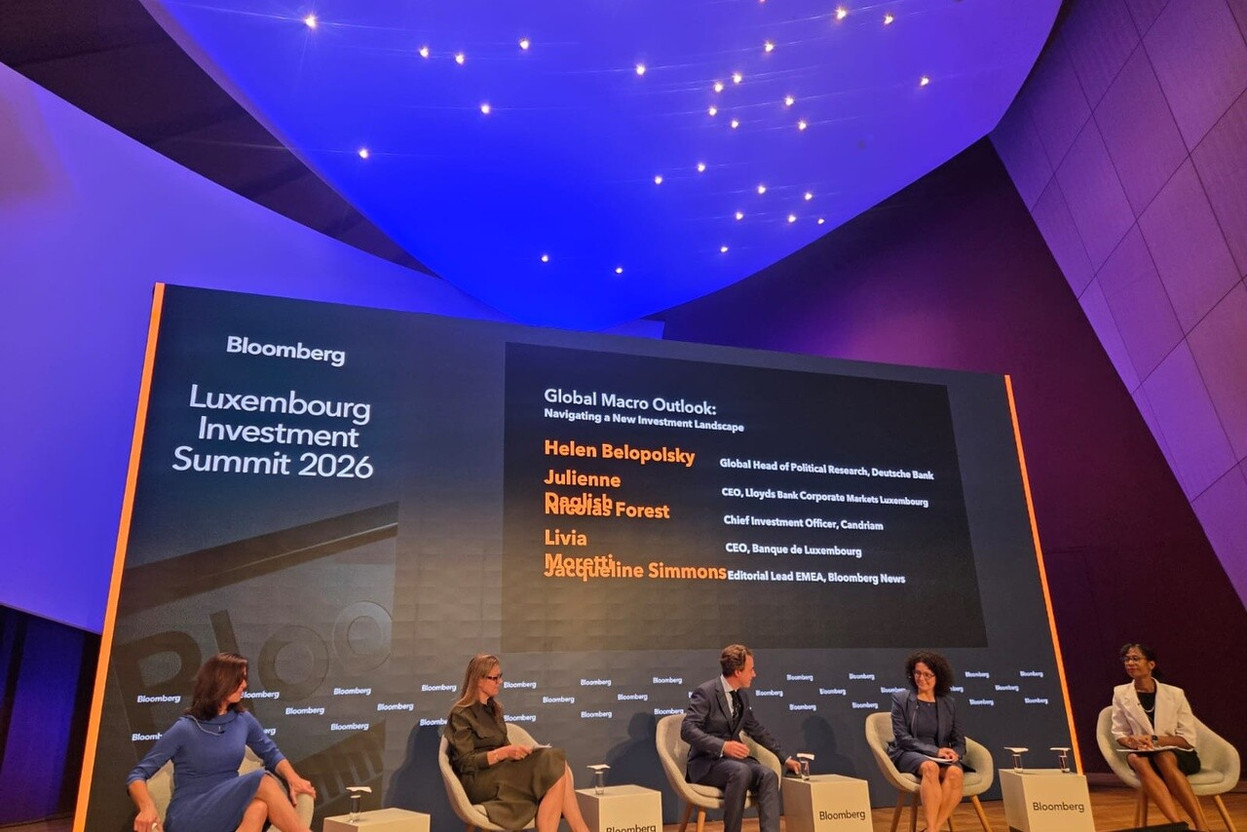
At one of his most recent conferences in Luxembourg whilst working for BLI – Banque de Luxembourg Investments, 
And what is emerging today is a lasting shift in the economic landscape. “We are in a new macroeconomic regime,” says Guy Wagner. The starting point for this is the build-up of public debt in developed economies, to which high budget deficits continue to be added.
In his view, this situation places central banks in an increasingly difficult position. They must combat inflation whilst ensuring that excessively high interest rates do not make the cost of servicing debt unsustainable.
‘Financial repression’ as a backdrop
For Guy Wagner, this contradiction leads to what he describes as ‘financial repression’: keeping real interest rates as low as possible – or even negative – in order to gradually ease the real burden of debt.
In his view, history provides a precedent. After the Second World War, the US debt-to-GDP ratio benefited in particular from exceptionally strong economic growth. A sustained acceleration in productivity – for example, driven by artificial intelligence – could now partly replicate this scenario. However, BLI’s CIO does not wish to make this his central scenario.
The other way to reduce the real burden of debt is through inflation. The implications for investors are significant. In this environment of currency depreciation, Guy Wagner favours real assets – shares, gold and commodities – over monetary assets such as cash and bonds.
This also means taking a different view of the concept of risk. Shares are certainly more volatile than bonds. However, in his view, this volatility is more a ‘price to pay’ for protecting the purchasing power of capital than a risk to be avoided at all costs.
The return of a ‘golden regime’
To characterise the current period, BLI uses, amongst other things, the trend in the ratio between gold and the Dow Jones. Over the long term, the asset management firm distinguishes between ‘equity cycles’, during which equities outperform gold, and ‘gold cycles’. According to Guy Wagner, the market has now returned to the latter category.
These periods have historically been associated with a loss of confidence in institutions and fiat currencies, as well as a growing preference for real assets. They also tend to reshuffle the deck within the equity markets: the US and large-cap stocks may lose their leading position to cyclical stocks, commodities or other international markets.
A significant departure from the past fifteen years, which have been characterised by the dominance of US equities.
The United States is underweighted
BLI’s portfolio therefore remains underweight in the US. Valuations are the primary reason for this. Guy Wagner points out, however, that the high valuations in the US market are largely concentrated in the sectors and large-cap stocks that dominate the indices. Added to this is a US dollar that BLI considers to be overvalued.
But he also highlights a risk that is less frequently mentioned: the United States’ very negative net external position, which is a consequence of the considerable amount of US assets held by foreign investors.
In a world where ‘financial nationalism’ is on the rise, Europeans might be more inclined to invest in Europe, and the Japanese in Japan. After fifteen years of significant capital flows to the United States, the US market would automatically be one of the most exposed to a wave of capital repatriation.
The Japanese gamble
At the other end of the spectrum lies Japan, to which BLI has significant exposure. Guy Wagner highlights, in particular, the improvement in corporate governance in Japan over the past decade or so. Having long been less concerned with profitability and shareholder returns than their US counterparts, Japanese companies now place greater emphasis on return on capital.
In his view, this change is only just beginning. Added to this are the end of deflation, more robust nominal growth and an economy well placed to benefit from the new global investment cycle, not least thanks to the presence of numerous industrial firms.
The country could also benefit from the repatriation of capital currently invested abroad. Finally, according to BLI, the yen remains significantly undervalued.
Gold rather than bonds
There is far greater scepticism regarding government bonds from developed countries. “Structurally speaking, bonds are currently in a bear market,” says Guy Wagner. He does not rule them out entirely: they may occasionally resume a stabilising role, particularly in the event of a recession, or serve as a liquidity buffer. However, for BLI, they no longer constitute the structural counterbalance to equities that they traditionally represented in mixed portfolios.
This function is now partly fulfilled by gold. BLI sees it as protection both against the loss of currencies’ purchasing power and against the fragmentation of the international monetary system. According to Guy Wagner, the freezing of Russian reserves in 2022 accelerated the desire of certain states to reduce their dependence on the dollar, contributing to the rise in gold purchases by central banks.
And despite the surge in the price of gold, Guy Wagner remains optimistic. In his view, saying that gold is ‘expensive’ makes little sense without specifying the point of comparison. When measured against the rise in debt or the money supply, he believes it still has significant potential. BLI currently holds this exposure mainly through mining royalty companies.
Raw materials are making a comeback
Another asset class has recently been added to the portfolio: commodities. The main argument is one of supply and demand. Years of underinvestment are limiting new production capacity at a time when demand remains high, particularly for the metals needed for infrastructure and electrification.
BLI also holds these assets through listed companies. At the end of August, the portfolio comprised 73.9% in shares, 17% in gold, 6.7% in energy and commodities, and 2.4% in cash. It held no bonds.
A statement that encapsulates the convictions Guy Wagner will pass on to his successor. For, as he points out, Fabrice Kremer shares the same assessment on the key issues. The handover should therefore not fundamentally alter BLI’s philosophy. However, it will change the way in which that philosophy is put into practice.