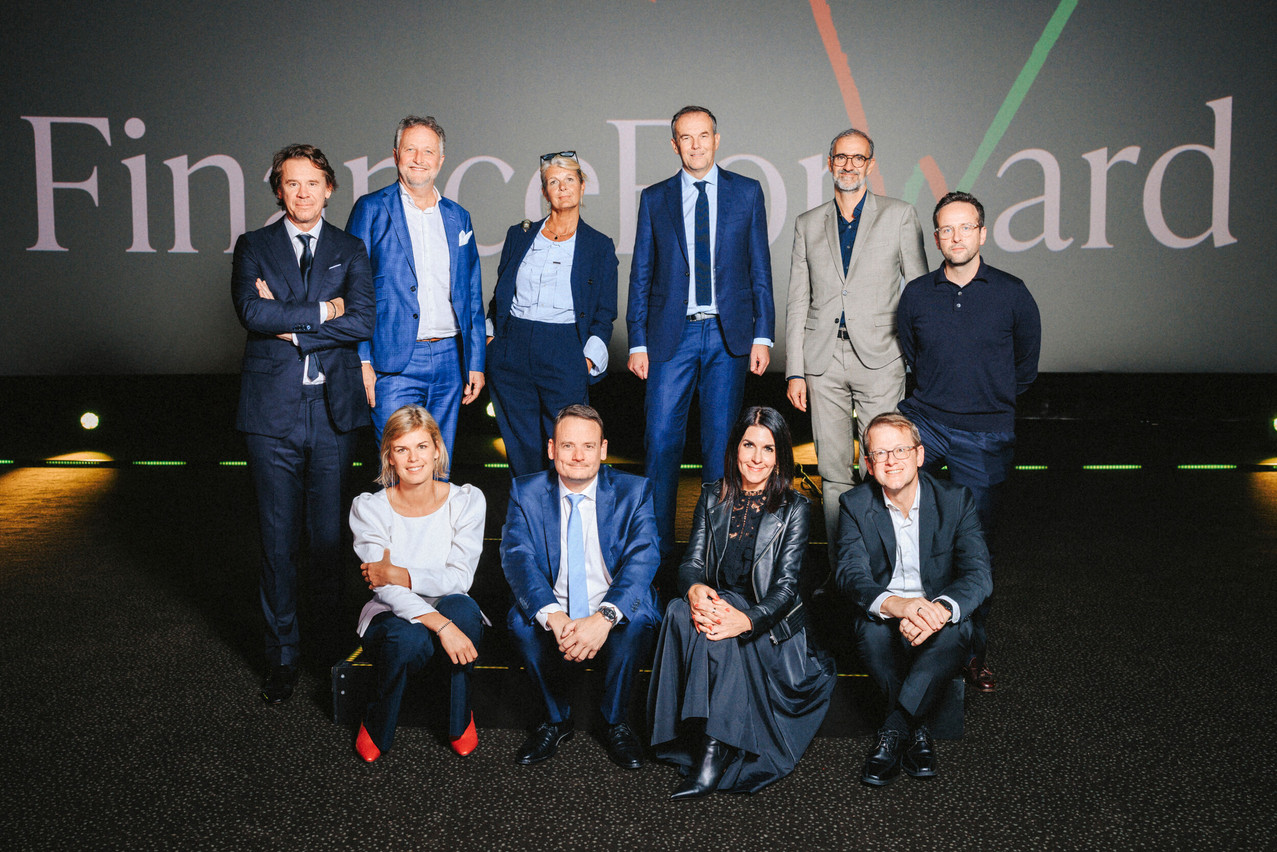
The world of finance is changing, and these transformations are already well under way. On stage at the Paperjam Club, the ten speakers at the 10x6 Finance Forward event, representing various sectors of the financial centre, shared their views on these changes. Five transformations – or even radical shifts – emerged from their presentations, with one constant theme running through them all: trust and responsibility.
The financial sector has already experienced a number of predicted upheavals: the dematerialisation of securities and the advent of the internet. Yet the financial centre has managed not only to hold its ground but also to grow. At the end of June 2026, regulated funds domiciled in the country accounted for €6,700 billion in net assets, and approximately €9,000 billion when all funds are included.
“What does this mean? It means that we have not only survived these various waves, but they have also enabled us to grow. Today, a new wave is coming and, in my view, it is the most significant of them all,” said the CEO of Depowise, 
The transformation now underway appears to be of a different, more profound nature this time. Artificial intelligence is no longer merely used to automate tasks. Combined with tokenisation, distributed ledgers and new payment infrastructures, it could enable the financial sector to carry out an increasing proportion of transactions itself.
From automation to autonomy
“Until now, financial technologies have mainly carried out decisions made by humans. The transformation will involve AI agents that can be given a objective, interpret a situation and decide on the action to be taken,” explained Melanie Moos.
But the scope goes further than that. Agents could just as easily select an investment, rebalance a portfolio, negotiate the terms of a loan or initiate a payment without requiring human approval at every stage.
This then raises the question of authorisation. “This autonomy shifts the problem, because when a piece of software makes decisions and takes action, who has authorised it? Its developer, the institution deploying it, or the client on whose behalf it is operating? After years dominated by ‘Know Your Customer’, the financial sector could be entering the era of ‘Know Your Agent’. Every agent will need to have a digital identity, a specific mandate and verifiable limits,’ emphasised the Head of Payments & Innovation at the ABBL, 
The question, therefore, is no longer simply how far AI can go, but how far the institutions are willing to let it go. The gains in speed will be inseparable from a new architecture based on the responsibility.
A fully programmable financial system
The second shift concerns the very foundations of the system. “We shouldn’t make the mistake of viewing tokenisation as a product. It is a new form of infrastructure. And what we are seeing today is the replication phase,” emphasised the founder of Investre, 
In his view, the proliferation of systems creates fragmentation that necessitates a series of checks, transfers and reconciliations. ‘The real question, then, is what happens when all these silos are linked within a single programmable environment. That’s where everything changes. Assets, money, identity and rules are connected and executed by lines of code – “smart contracts”. These multiple processes are replaced by a single one, which checks whether the asset I want to buy is available, whether the funds are there and whether I am compliant. This obviously brings about a fundamental change. Because if we look at the current system, it is, by design, based on intermediaries,” he explained.
Interconnected risks
The very same infrastructure that would enable financial services to be automated and interconnected would also make them more dependent on one another. A failure at a data centre could affect banks and payment systems, as well as airlines, logistics networks and millions of users... A disruption no longer stops at the point where it begins.
“One disruption, multiple sectors, cascading consequences. That is what we mean by interconnected risk. For us, as risk managers, this implies a fundamental shift in perspective: we can no longer consider an investment or an asset in isolation. We must understand and take into account the entire ecosystem. This is where things get particularly interesting: the very infrastructures that create new risks also open up extraordinary opportunities,” said Swiss Re’s General Manager for Luxembourg, 
The need to mobilise savings
The CEO of Clearstream Services, 
And for him, the solution could lie in three points: “Firstly, we must mobilise private capital. Around 15,000 billion euros is reportedly sitting in bank accounts, without directly funding the businesses and infrastructure that Europe needs. Secondly, we must develop and protect the world-class infrastructure we already have. Thirdly, we must be bold and fully embrace new technologies, such as tokenisation and AI. Tokenisation is not limited to cryptocurrencies. An investment represented in digital form, settled instantly and distributed in fractional units constitutes a new type of investment, capable of attracting new investors.”
The issue also concerns pensions. According to the figures put forward during the evening, reforms could channel several thousand billion euros of savings into the capital markets. Private assets are also expected to continue to gain ground amongst institutional investors and high-net-worth clients.
For Luxembourg, the opportunity is clear, as the financial centre already has the vehicles, expertise and infrastructure in place. But its position alone will not be enough. According to the CEO of Liser, Prof. 
‘For finance possesses extraordinary power. It enables money to transcend time. Finance moves money from the past to the present; it also shifts – or even transforms – future income into immediately available resources, but it does much more than that. It keeps money circulating within the economy. And when money circulates through the economy, it is like a beating heart. Then the economy comes to life; it transforms, it develops, it grows. There is no life without movement, no development without innovation. ‘There is no productivity gain without investment, no discovery without risk-taking, and no human progress without training,’ she said
Trust itself becomes the infrastructure
Two speakers placed particular emphasis on the concept of trust as an unshakeable foundation in the face of the many disruptions mentioned. “Luxembourg has become a financial centre of choice for investors and clients. And this choice is by no means a matter of chance: it has been built up over time. It is not simply down to regulation or taxation. The real secret lies in the way we work together. Lawyers, consultants, bankers, asset managers, insurers, regulators, public authorities: public and private sector players come together around the same table. And an entire ecosystem has learnt to stop asking ‘Why is this impossible?’, but rather ‘How can we make this possible?’. And among the factors that will ensure our success in the future, the foremost is trust. Technology will evolve, but trust will remain our foundation. For a country of our size, it is essential to our very existence,’ he assured 
“The winners in private banking tomorrow will not be those with the greatest number of AI tools, but those who know how to combine trust, relationships and technology,” added 
The client relationship, too, cannot do without this profoundly human dimension. In private banking, AI may be able to prepare meetings, analyse portfolios, take notes and handle administrative follow-up, but advisers will still need to listen, interpret clients’ needs, check recommendations and present the results in a way they can understand.
Nicolas Otton, CEO of BGL BNP Paribas, who brought the presentations to a close, also stressed the importance of trust: “The more we digitise, the more important the human element will become.”