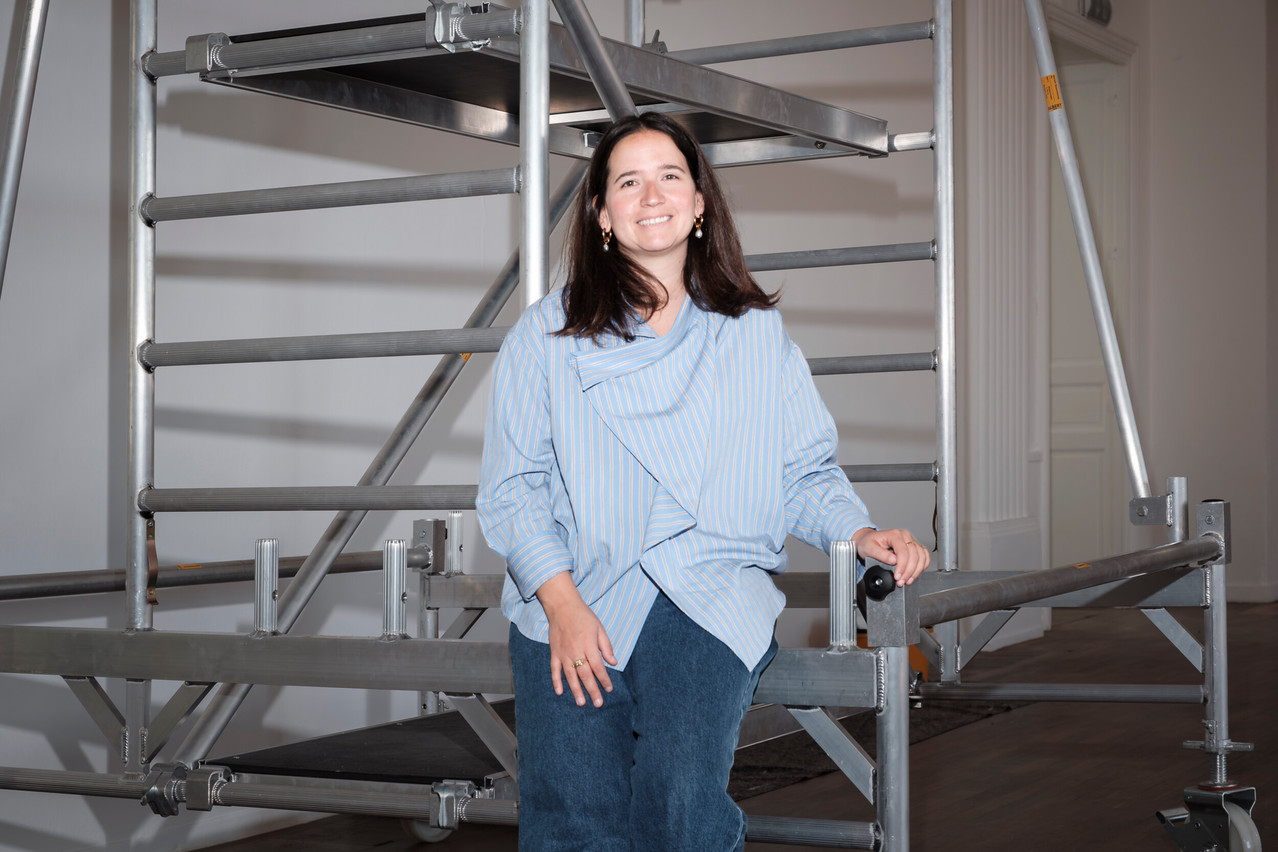
With 78% of galleries coming from abroad, the 2026 edition has a strong international dimension. Why is this important?
“This international dimension is part of Luxembourg Art Week’s identity,” explains Mélanie de Jamblinne, Director of the event. “Our ambition is to attract more collectors and professionals from abroad, while remaining an unmissable event for our local audience. For people living in Luxembourg and the Greater Region, the fair offers an opportunity to discover, in one place, artists and works from a wide range of art scenes.”
We want Luxembourg Art Week to be a platform that brings together galleries, artists, collectors, institutions, businesses and the public.

What does the presence of international galleries bring to Luxembourg exhibitors and artists?
“Quite simply, opportunities. In 2025, we welcomed 77 art galleries and more than 17,000 visitors. Professionals and collectors have the chance to discover artists whose work they may not yet know. For artists, it is also an opportunity to engage directly with the practices of other art scenes. For galleries, the fair naturally provides an opportunity to meet new collectors and representatives of institutions, but also to build relationships with fellow galleries from abroad. These exchanges can lead to collaborations, or even to an artist being represented in another country.”
What impact does Luxembourg Art Week have on Luxembourg’s cultural ecosystem?
“We have always wanted Luxembourg Art Week to be a gateway that helps break down barriers between audiences unfamiliar with contemporary art and the art world, as well as a platform for exchange and relationship-building among cultural players in the Grand Duchy. Galleries, museums, independent cultural spaces, businesses and others can discover artists, lay the foundations for future exhibitions, identify works that could be loaned or acquired, and meet professionals from abroad. The fair therefore gives Luxembourg’s cultural organisations an additional platform from which to raise their profile and showcase the local art scene beyond our borders.”
Speaking of borders, the exhibitions extend beyond the Glacis…
“Indeed. We work with various organisations across the country to ensure that this momentum is not confined to the marquee at the Glacis. We have developed partnerships with cultural institutions and players from the art world. For example, our conference programme gives a voice to local cultural figures, while a performance programme is developed in collaboration with Mudam. Our opening night, as well as guided tours, are organised at Casino Luxembourg…”
What is your ambition for Luxembourg?
“Beyond raising awareness of the fair itself, we want to give international visitors another reason to come to Luxembourg. Off-site events such as the Art Walk allow both local and international audiences to discover Luxembourg City in a distinctive way. In this way, Luxembourg Art Week extends into public spaces, bringing art into everyday life, where people live, pass through and meet,” explains Mélanie de Jamblinne.
Luxembourg Art Week extends into public spaces, bringing art into everyday life, where people live, pass through and meet.

Which countries do the exhibitors come from?
“France, Belgium and Germany are strongly represented due to their proximity, but we also welcome galleries from Spain, Italy and Ireland, as well as from outside Europe. This diversity is essential because it exposes visitors to different artistic perspectives.”
Which artists and galleries will visitors be able to discover at this year’s edition?
The fair’s Director hesitates, as she says, “It is difficult to mention everyone, but, for example, Christophe Gaillard, exhibiting in the Main Section, will present works by visual artist and painter Hélène Delprat. Photographs by New York artist Vivian Maier will be on view at the Les Douches la Galerie stand. Galerie Lelong will highlight the work of painter Fabienne Verdier. Visitors will also be able to discover selections of works presented by Alzueta Gallery, HANGAR, STUDIO23, Stems Gallery and Galerie Heike Strelow. Galerie Zlotowski, meanwhile, will exhibit works by American artist Eugene J. Martin, known for his paper collages.
“And, of course, Luxembourg galleries will also be represented, including Ceysson & Bénétière and Nosbaum Reding, as well as Zidoun-Bossuyt, which will present a solo show by the duo Martine Feipel and Jean Bechameil. As every year, the Take Off section will also offer strong visibility to galleries from Luxembourg and abroad, including Porte B., Grège Gallery, MUNHOVEN & RIFF, NADAN, VGalerie – Elena Valentiny and Galerie Pauline Renard…”
Can anyone afford to buy a work of art?
“Of course! It is worth knowing that some editions can be purchased for a few hundred euros, with prices sometimes starting at under €100,” says the fair’s Director enthusiastically. “That is why we introduced Collecting 101. A sticker identifies works priced below €4,000. The aim is to make art more accessible and enable people who are not yet collectors to acquire their first works. The initiative also aims to encourage dialogue between contemporary art enthusiasts who have never yet taken the step of buying a work and gallery owners.”
Does this year’s Focus Photo also reflect this desire for greater accessibility?
“Yes. Photography is a very immediate and familiar medium, even when it becomes experimental. It often provides a gateway into contemporary art. As photographic works are frequently produced in editions, their prices can also be more affordable, making a first acquisition easier. Focus Photo will take several forms: some galleries will devote their entire stand to photography, while others will showcase one or two photographers on a dedicated wall. This focus will also extend to the conference programme, with topics including women photographers and photography as cultural heritage.”
Any final words for those planning to visit Luxembourg Art Week?
“I would encourage them to get their tickets on our website, come along and simply discover the fair, allow themselves to be surprised by the works and engage with artists and gallery owners. That is also what Luxembourg Art Week is about: encounters, discoveries and a great deal of passion to share. We look forward to welcoming you!”